


FIND OUT MORE ABOUT OUR SOFT LIGHT EXHIBITORS
Soft Light contemplates light in the darkest months of the year, showcasing paintings, photography and installations that masterfully capture sunlight, moonlight and artificial light alongside contemporary craft from UK-based artists and makers.
Alan Stones
Alan Stones is a painter and printmaker based in Cumbria’s Eden Valley. Since graduating from St. Martin’s School of Art in 1971, he has worked full-time as a painter, drawer and printmaker.
In 1984, Alan won an award from the Gulbenkian Foundation to experiment in printmaking. This was the beginning of a prolific career and he has gone on to make some 150 editions of lithographs.
Alan has exhibited widely, including UK-wide touring solo exhibitions, a three month residency on the Falkland Islands, and recently, three large solo exhibitions in public galleries in Cumbria. Alan is a Patron of Printfest, the artist-led annual printmaking festival based in Ulverston, Cumbria.
Tea Room Reservation
“I’d undergone minor surgery at Whitehaven Hospital. When my wife collected me, she told me about the lovely time she’d just had at a café overlooking the sea. Her description of her day was brilliant, so we returned to the café where I hoped to experience something of what she’d enjoyed so much. I do think that my response to this occasion, painting Tea Room Reservation, was in reaction to the stress I’d been feeling prior to my operation.”
In Tea Room Reservation, bright sunlight falls directly onto a window surround at the edge of the painting. This leaves the room in a sort of shadowy afterglow. Whoever has booked the table in the tea room has not yet arrived. All is still and muted, apart from the tip of a plastic daffodil which is momentarily touched by a direct ray of sunlight.
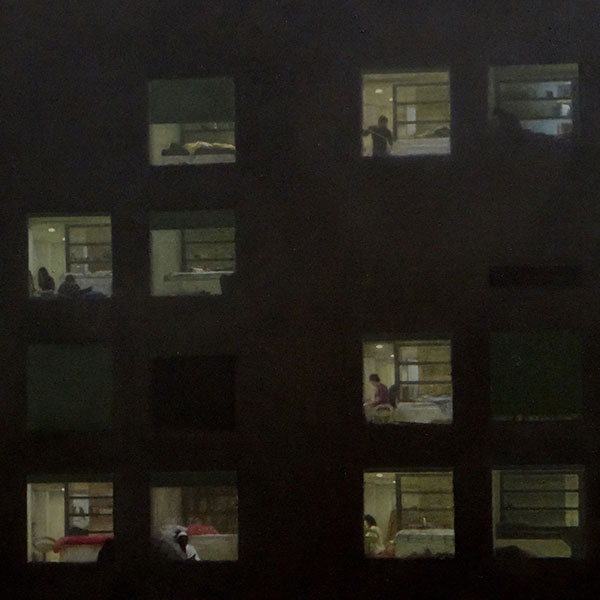
Hotel du Monde
“This painting is one of a number of studies for a much bigger painting (with 36 windows) I’m currently working on. In each painting, we are looking at the façade of a building, perhaps a hostel or a hotel, in the evening. In this study, two dozen windows are visible to us. Each has a blind – some blinds are open, some partly open, some closed and some rooms have the lights on, giving us an occasional glimpse of an occupant. Who are they? What’s on their minds?
I am thinking of these rooms as metaphors for the mind of the occupant – or perhaps aspects of my own mind. In the bigger painting back in my studio, some rooms will be cluttered and others organised. Some are bright and cheerful rooms, whilst others are quiet sanctuaries. I’m hoping that, when finished, it will carry my wonder – a curiosity with the lives of others.”
April Key
April Key is a British artist and sculptor working across hand-bent neon glass, mixed materials and digital processes. With a background in architecture, her practice explores light, structure, colour and place.
Originally from Yorkshire, April studied at Edinburgh College of Art before moving to Istanbul, where she developed her artistic practice and began working with neon. She returned to the North of England in 2023, continuing to explore the relationship between sculpture, light and material. Her work draws on personal and found imagery, local histories, architecture andcultural memory, translating these narratives into sculptural forms.
Working primarily with hand-bent neon glass, April explores the material as both light and object: fragile, physical and shaped by the hand. Recent work brings neon into dialogue with natural forms, landscape and vernacular stories, moving beyond conventional linear neon towards larger sculptural installations and groups of forms.
Her practice spans studio work, public art, commissions and collaborative projects, with an ongoing interest in contemporary sculpture and storytelling.
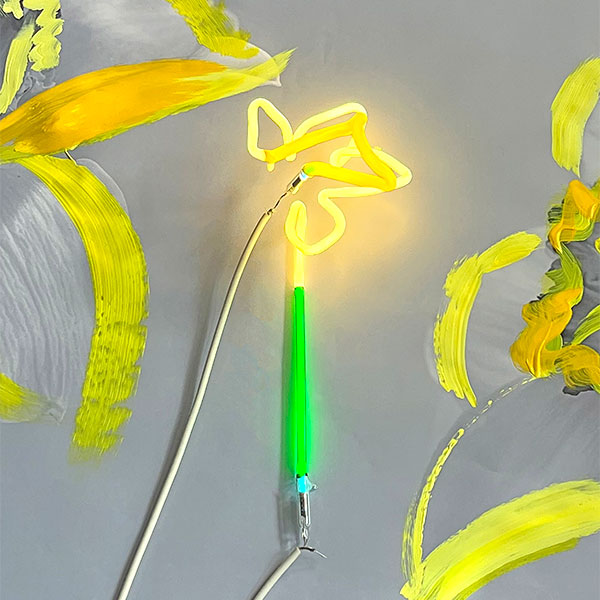
In Soft Light, April has used the familiar symbol of spring, the daffodil, as the starting point for a series of sculptural works that bring together natural forms, constructed architecture and neon light.
Rather than representing the flower in a traditional or botanical way, April has reinterpreted its recognisable form through her interest in structure, material and light. The flowers are hand formed in neon glass, allowing the lines of the petals and stems to become both drawing and sculpture.
Light is central to the works. When illuminated, the neon transforms the simple outline of the daffodil into something more graphic and spatial. Colour and light alter the way the flowers are perceived, shifting them away from their familiar natural appearance while retaining enough of their original form to remain recognisable. The exposed elements of the neon, including the connections and cabling, are also left visible rather than concealed, allowing the process of making and the material qualities of the glass to remain part of the sculpture.
The series reflects April’s wider interest in bringing together architectural forms and more organic or found imagery. Here, the daffodil becomes a way of exploring that relationship through a familiar subject. The works sit between sculpture and drawing, using neon not simply as illumination but as a material with which to construct form.
Hannah Guy
Hannah Guy is a Leeds-based photographic artist whose practice explores dreams as social texts. Drawing from her own and others’ dream accounts, she reconstructs fragments of the unconscious through staged, long-exposure photographs that move between documentary and fiction. Using colour, artificial light and repetition, Hannah examines the unstable space between memory, imagination and lived experience.
Developed through listening and collaboration, her work considers how dreams can carry private emotions into shared visual form. Informed by psychoanalytic thinking, she is interested in photography’s capacity to make subjective experience encounterable without fixing it into a single meaning.
Hannah graduated with First Class Honours in BA Fine Art from the University of Leeds in 2024 and undertook the Accelerator Bursary with Leeds Art Gallery and Assembly House in 2025. Since graduating, she has displayed her work across West Yorkshire, including her solo photography presentation ‘In Light of Waking’ in Leeds Art Gallery in January. Hannah has also exhibited at Barnsley’s Inaugural Foto Festival, The Big Love Show, Playspace in Leeds Art Gallery, Old Parcel Office, Scarborough. She is currently based at Assembly House, Leeds.
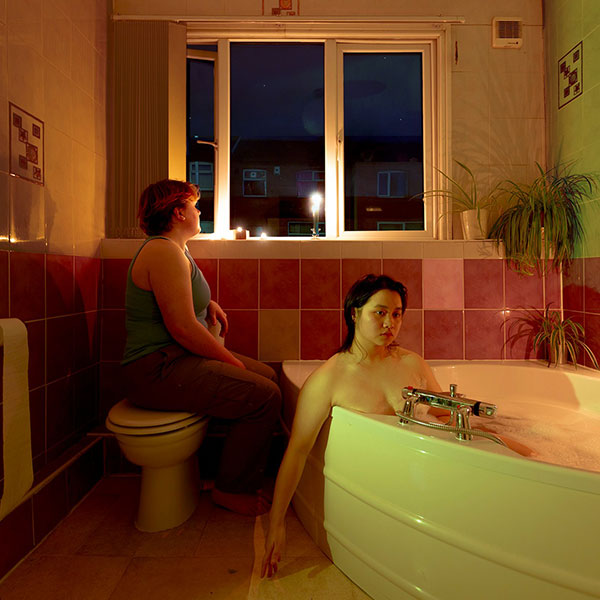
The four photographs featured in Soft Light are drawn from Hannah’s ongoing projects In Light of Waking and Nightmares and Daymoths, both of which begin with collected written accounts of nighttime dreams: anonymous submissions, conversations and automatic writing. Hannah approaches these accounts not as fixed narratives to be illustrated, but as shared material. As a dream is spoken, heard and remembered, it changes. Her photographs begin within that movement, translating something private and unstable into a scene made collectively in front of the camera.
Working with friends and participants, Hannah constructs each image through performance, long exposure and artificial light. Made across Holbeck, Kirkstall, Headingley and Beeston, the works remain rooted in recognisable, lived-in parts of Leeds while allowing those places to become slightly unfamiliar. The city enters the photographs through texture as much as geography: bathwater, shimmery glazed tile, dry rubble, wet quarry stone, weeds, windows and broken ground. Wetness sits against dust, bare skin against stone, and domestic light against the density of night.
Long exposure allows light to be accumulated across the frame rather than simply captured in an instant. Green and amber pool and gather on skin; red enters rock and soil; windows burn against dark exteriors. This extended duration gives the images a heightened, almost mnemonic clarity, while retaining the camera’s descriptive precision. Hannah uses this tension to question photography’s familiar claim to evidential truth. The scenes are visibly constructed, but that construction does not diminish the emotional or bodily realities they hold.
Across the work, dreaming functions less as a subject than as a method of translation. An anonymous dream becomes language, conversation, performance, light and finally image. At each stage, its authorship loosens and new associations accumulate. By the time the photograph is made, the originating dream no longer belongs entirely to one person.
Hannah’s photographs occupy this unstable space between private experience and collective construction. Neither documents of dreams nor illustrations of them, they are staged encounters in which memory, desire and shared imagination are given temporary physical form.
Hannah Slater
Hannah Slater is a multidisciplinary designer based in North Yorkshire whose practice explores the relationship between material, form and spatial experience. Her work is rooted in an interest in natural landscapes and organic abstraction, translating observed structures, textures and rhythms into contemporary functional objects.
As the recipient of a First Class Art and Design degree from the University of Leeds and a finalist in the FUAM graduate Art Prize 2025, Hannah works across lighting and product design, combining digital fabrication with traditional processes of making, including 3D printing, casting and material experimentation. Her practice considers the point at which functional design intersects with sculpture, paying particular attention to tactility, atmosphere and the emotional qualities of objects within an interior.
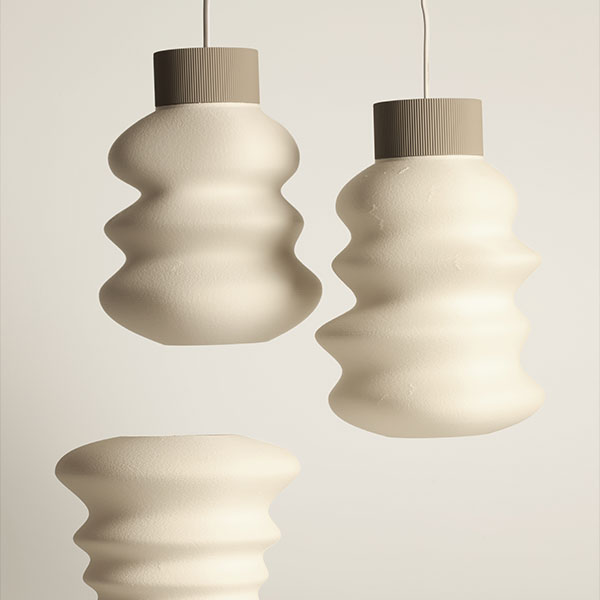
The 3D-printed lighting collection featured in Soft Light is informed by the naturally stacked formations of Brimham Rocks in North Yorkshire. Rather than reproducing the landscape literally, Hannah abstracts its distinctive contours, asymmetry and sense of balance into a series of sculptural forms.
The process begins with interpreting the key elements of the formations through sketching, which are then developed on 3D software to create the final forms. The layered quality inherent to the 3D-printing process echoes the sedimentary structures of the rocks, creating a dialogue between natural formation and digital fabrication. The visible traces of the manufacturing process are retained as part of each piece, emphasising the relationship between material, process and form.
Modularity is central to the collection. Individual components are connected through a twist-lock mechanism, allowing the forms to be assembled, repositioned and reconfigured according to their environment. The resulting system can be used across table, pendant and floor configurations, challenging the idea of lighting as a fixed object and instead allowing it to evolve in response to its surroundings and the needs of the user.
Alongside the 3D-printed works, the jesmonite Ridge lamp explores a more tactile approach. Its organic form and textured surface draw on the irregular qualities of natural bark, creating an invitation to touch and engage with the object. Similarly to The Brimham Collection, the design is developed digitally in 3D software; however, the printed model is used to create a silicone mould for casting the jesmonite. This introduces a different weight, texture and sensory experience.
Across both bodies of work, Hannah is interested in the space between function and sculpture. Her practice embraces organic abstraction, material experimentation and how form interacts with light, even when unilluminated. The resulting pieces are intended not simply to illuminate a space, but to contribute to its atmosphere, encouraging a slower and more considered relationship between object, user and environment.
Helina Bassey
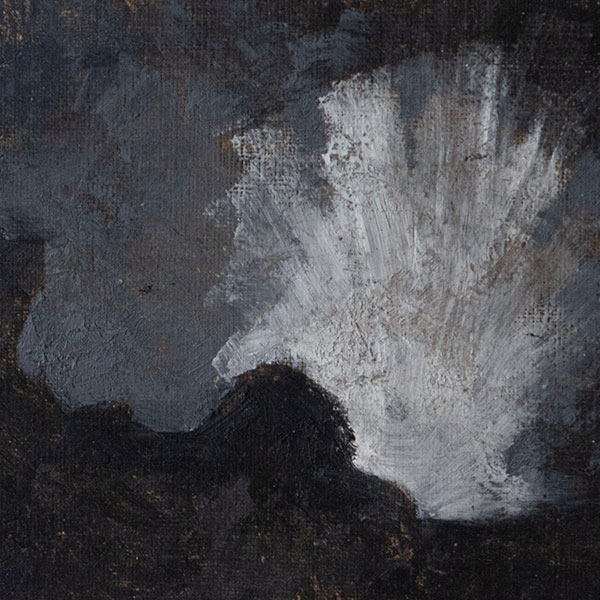
Helina Bassey is a Calderdale-based artist, primarily working in acrylic and oil to create minimal paintings that move between abstraction and landscape. Through restrained colour, reduced forms and shifting relationships between light and dark, her work explores atmosphere, memory, landscape and emotional presence. Increasingly, forms become less identifiable, allowing shape, space and surface to carry their own weight while retaining a sense of something observed or remembered.
Helina’s process is slow and meditative, welcoming imperfections by involving repeated layering, scraping back, obscuring and reworking until a sense of equilibrium emerges. What initially appears minimal gradually reveals traces of earlier decisions, subtle tonal shifts and quiet gestures embedded within the surface.
Helina’s paintings seek to hold space, offering moments of stillness and introspection within an accelerated world. Reduction is central to her practice, not as an absence of information, but as a way of creating room for contemplation. Moving between recognition and uncertainty, the work invites the viewer to pause and encounter what is felt as much as what is seen.
“The series of paintings featured in Soft Light consider landscape through its most reduced elements: a horizon, a cloud, a moon, a fragment of light. The works move between observed landscape and abstraction. Places encountered become altered through memory and through the physical process of painting, layering, obscuring, scraping back and revising. Traces remain, so that each surface carries something of what has been removed as well as what has been retained.
Across the series, Held Light, light becomes a recurring point of orientation: distant, dispersed, sometimes barely present. Rather than describing particular places, the paintings dwell on the moment when recognition becomes uncertain, and landscape is experienced through atmosphere, minimal palette, memory and light.”
Jay Caskie
Jay Caskie is a wood engraving printmaker originally from Canada and now living in Cornwall. He studied printmaking at NSCAD University in Halifax, Nova Scotia and received his BFA in 2019 before moving to the UK in 2020.
Now based in Cornwall, he works from his studio in Redruth, exhibiting regularly in exhibitions across the UK and internationally, including the Society of Wood Engravers Annual Exhibitions, the RWA Annual Open Exhibition 2025, and the annual Great Print exhibitions. Recently elected as a member of the Society of Wood Engravers, Jay is passionate about the art of wood engraving and promoting traditional printmaking techniques.
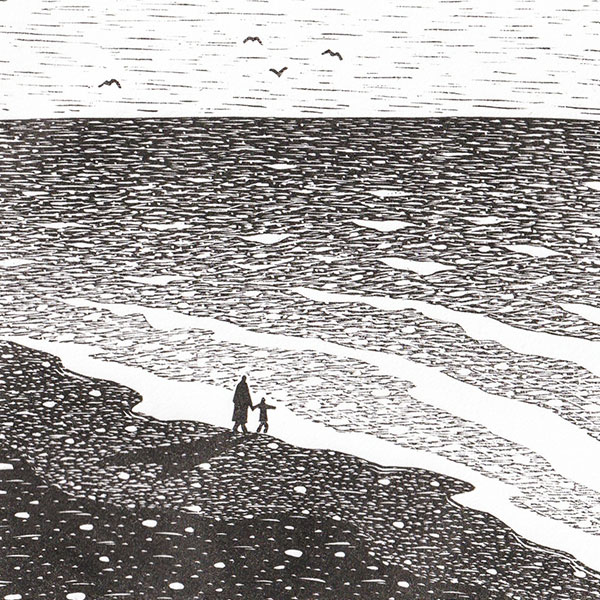
Inspired by the vastness of the Canadian landscapes where he grew up, and the rugged beauty of the Cornish coastline where he lives now, Jay creates intricately detailed landscapes that explore themes of place, solitude, and connection to the natural world.
His prints serve as windows into contemplative scenes, the intricate details holding the viewer’s attention and fostering a sense of introspection and reflection. He aims to convey not only the physical attributes but also the emotional resonance of the landscapes.
Jay uses the traditional technique of wood engraving to create his landscapes. Wood engraving is a type of relief print that lends itself to detailed black and white image. Creating an engraving requires a deep appreciation of light in order to translate an image into wood. The artist starts with a blackened woodblock and slowly creates the image by removing the light areas with fine-tipped burins.
It is the opposite of most drawing practices that start with a white page and the drawing is created by adding shadow. In wood engraving, the artist draws with light instead of shadow. All the areas that have been removed will show up white when printed, and the areas that are left will pick up ink and be printed in black.
Jay uses this technique to capture the full tonal range of the landscapes, from the deep blacks to the bright highlights. He is interested in how light forms and transforms the landscape, and is particularly drawn to the contrast between the very dark and very light areas, using this contrast to draw the eye to certain elements in his scenes. He enjoys the repetitive nature of the mark-making, using his engraving burins to create shining stars in a dark sky, the sparkling reflections of moonlight in the water, and the swirling snowflakes of a winter storm.
Jessie Butler
Jessie Marie Butler is a multidisciplinary artist whose practice explores memory, perception and the emotional resonance of domestic spaces through miniature sculptural installations.
Working across sculpture, light, shadow and sound, she creates immersive environments that transform familiar architectural forms into. intimate spaces of reflection. Her work examines how scale, atmosphere and sensory experience shape lived experience, inviting viewers to consider the boundaries between reality and imagination. Through quiet, carefully constructed installations, Jessie evokes familiarity, absence and nostalgia, encouraging personal interpretation and emotional connection.
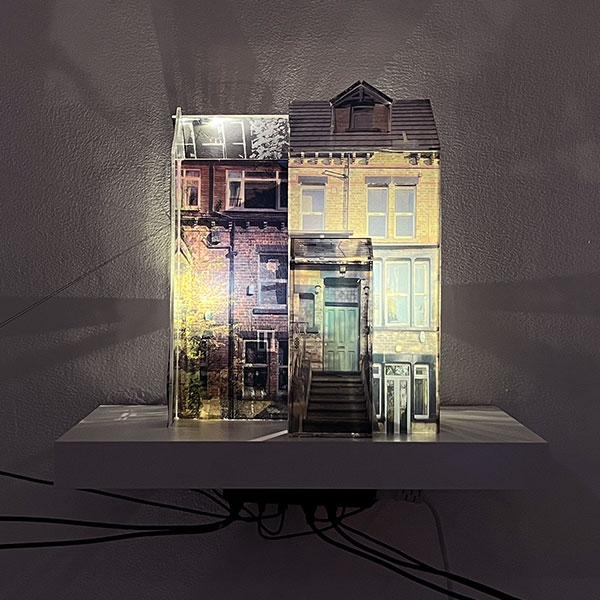
Houses Still Lit is an installation exploring how architecture can hold feelings of memory, familiarity and imagination through light, sound and shadow. The three miniature houses are based on three places Jessie has lived in while in Leeds. Although each structure originates from a real and personal space, the houses have been transformed through layered transparent photographic images, making them fragmented and uncertain. They shift between something recognisable and something more abstract, moving away from a literal representation of the places they are based on.
Light passes through the structures, casting their forms and shadows onto the surrounding space. The physical houses and their projected shadows become different versions of the same place, changing depending on how they are seen. Layered voices and sounds play from speakers within the installation, adding another layer to the spaces. The voices feel like fragments of conversations or memories, while the overlapping sounds create an atmosphere that is familiar but difficult to place. This layering reflects the transparent images, with each element revealing and obscuring something at the same time.
Although the work begins with personal places and memories, it is intentionally not completely autobiographical. The use of transparency, fragmentation and sound allows the houses to become less specific, leaving space for the viewer to form their own associations. They can be understood as remembered spaces or imagined environments.
Through light, shadow, transparency and sound, Houses Still Lit explores the space between what is remembered and what is imagined, and how something familiar can become unfamiliar when it is seen differently.
Joanna Byrne
Joanna Byrne (she/her) is a Bradford-based artist filmmaker who takes material, collaborative and sustainable approaches to creating moving image. She is interested in the therapeutic and transformational potential of experimental, participatory film practices – connecting us to ourselves, each other and our environments.
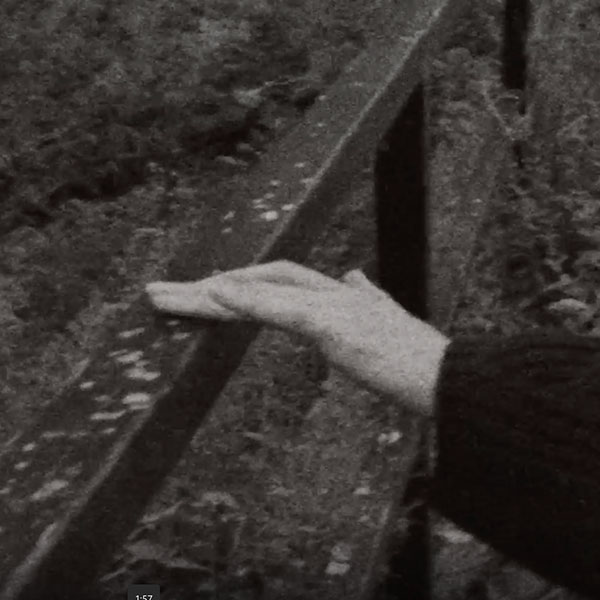
Joanna works with analogue film (super 8mm, 16mm and 35mm film) in a tactile way – incorporating alternative photographic processes, hand-manipulation and physical traces of her body into the work. She also works with live projections, sound and installation to create immersive expanded cinema experiences. Her work has been screened across the UK and internationally within cinema, gallery and non-traditional contexts.
Last year Joanna was commissioned by Yorkshire Contemporary to create Past Lives, an immersive multi-channel installation with soundscape for Bradford 2025. The work was rooted in a deep, multi-sensory investigation of an accidentally rewilded urban waste ground close to Joanna’s home, and the past, present and potential future lives of the site. The piece was created using sustainable filmmaking processes, including darkroom printing and hand-processing in collaboration with wild plants foraged at the location (grasses, stinging nettle, marsh thistle, hedge mustard and valerian). Past Lives was longlisted for the Aesthetica Art Prize 2026, and will be restaged at Sunny Bank Mills for the exhibition Soft Light.
Marcus Jacka
Originally from Australia, Marcus (aka Non-Standard Furniture) came to the UK thirty years ago as a research physicist and lecturer at the University of York. Although there was a creative engineering side to the work, the strong need to be a maker meant he left after a few years to become a full time furniture maker and wood turner.
“To some extent, my scientific background still informs my work – for me, good design is pared back to the point of being elemental, and there is careful consideration to the qualities of the materials I use. I aim for work which is well thought out, but not clever for the sake of it, nor virtuosic.
The Non-Standard studio is located on the edge of the North York Moors national park, in a beautiful quiet valley. The surrounding countryside, the shapes of the land and trees, and the changing light on the hills opposite guide and inspire. I run a small, somewhat traditional workshop, making limited runs of furniture, lighting and bespoke commissions.”
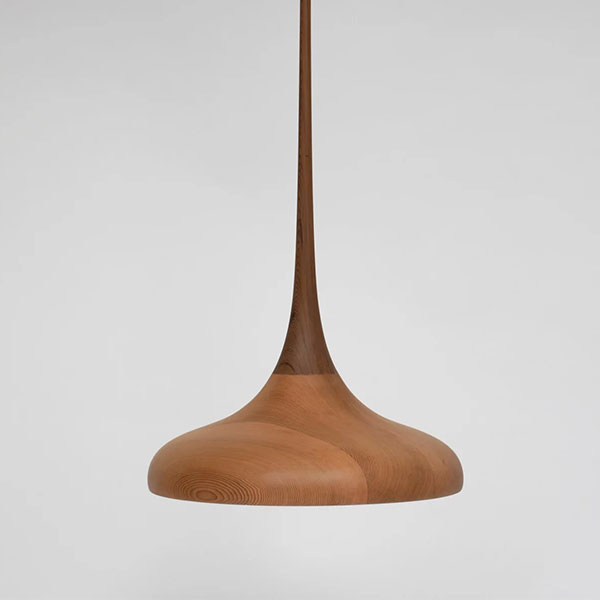
The two pieces on show as part of Soft Light, Botanic 2 pendant lamp and Flambeau (non) standard lamp are part of the Non-Standard collection of botanical inspired lighting. Botanic 2 comes from the idea of a flower partially open, whereas the Flambeau resembles a huge pendulous seed pod, as well as the flaming torch which gives its name. Both are made from Western Red Cedar which is light, fragrant, and suitable for turning in large sections. It has a huge range of colour and grain variation and also responds well to the Japanese method of being burnt and scrubbed back to give a wonderful black textured surface.”
Orla Kane
Orla Kane is a Scottish artist based in Glasgow. She graduated from The Glasgow School of Art in 2021 before attending the Royal Drawing School’s Intensive Term in 2022.
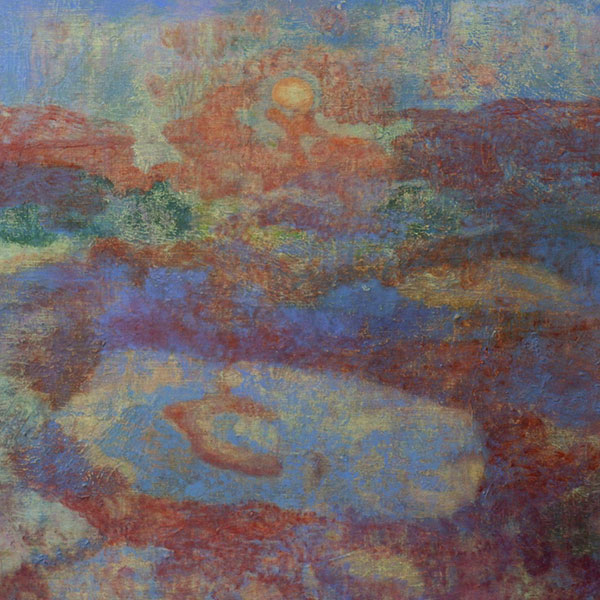
Orla’s practice is a poetic exchange between landscape and recollection. Unfolded memories are re-contextualised by everyday moments morphing into psychedelic iterations on colour, time and place. Working predominantly with oil paint, she is interested in surface and the application and removal of paint.
Compositions are built up slowly from loosely weaved marks which glide and scratch into the surface, defining shapes that over time resemble landscapes. Her landscapes are inhabited by a collection of motifs, whimsical forms of suns, moons and flowers dance across her compositions and collapse into ephemera, their shadows erupting and merging into landforms or bodies of water.
Recent solo exhibitions include Landslides, 2026, More Moons Than Suns, 2025 and Fields Adrift, 2024 at Blue Shop Gallery, London, Star Face, 2023, Boardroom Committee Room, Glasgow and Daisy Chains, 2022, Stallan-Brand, Glasgow.
Paul Merrick
Artist and educator Paul Merrick has over 20 years’ experience and expertise of making works for exhibition, exhibiting nationally and internationally in galleries, museums and art fairs. He has works within Museum and Private Art Collections including the Rosa Esman Collection, The Laing Art Gallery and The New Art Gallery Walsall Collection. He recently had work included in 2025 John Moores Painting Prize, Walker Art Gallery, Liverpool.
In addition to his practice, Paul has extensive education experience spread across a wide range of teaching environments. Within academia, he has over 10 years’ experience of working on Fine Art courses at Newcastle, Northumbria, Teesside and Loughborough Universities. As a freelance artist, he has devised and delivered bespoke art projects within educational settings at BALTIC, NGCA, Woodhorn Museum, Great North Run Culture, Gateshead Arts Team, Schools and colleges in the Northeast. His studio is located at 36 Lime Street Studios and Workshops in the Ouseburn, Newcastle upon Tyne.
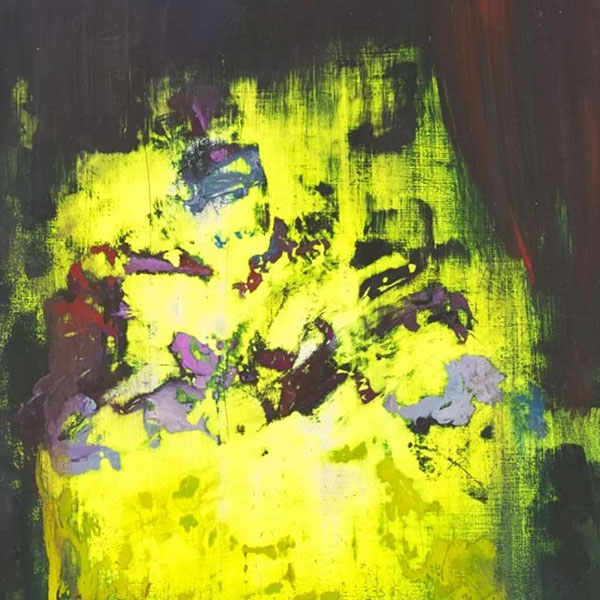
“These paintings translate found photographs in order to pay attention to and explore the materials’ actions of picturing. Like the forms they depict, pictures are only seemingly static, examining a picture reveals a constant state of flux and becoming.
National Geographic magazine images from the 1950s and 60s continue to pre-occupy my practice. Published at a time when the world was a larger place, this iconic magazine provided windows into hidden traditions, mysterious landscapes and beguiling portraits with its reportage and unique vintage palette.
The paintings are meditations, each exploring a new focus, a balance between figuration and abstraction, thick paint contrasting against thin or fluorescent grounds creating their own strange light. Painted on aluminium, the oil paint is worked and reworked either using an electric sander or by hand. The excavation of the surface is crucial to the process, revealing previous layers of paint to unveil a new image of forgotten places from another time. “
Scarlet Brown
Scarlet Brown is a figurative landscape painter and recent BA (Hons) Fine Art graduate from Leeds Arts University and is currently based in her hometown, Barnsley.
Her work presents intentionally unnerving and unquiet landscapes which explore and reflect on the uncertainty of our current times and the unknown future of the environment. Through ambiguous narratives and the merging of physical and imagined spaces, the work invites the viewer to experience enigmatic worlds that explore dark concealing spaces to uninhabited chaotic scenery that contain subtle aggression and supernatural implications.
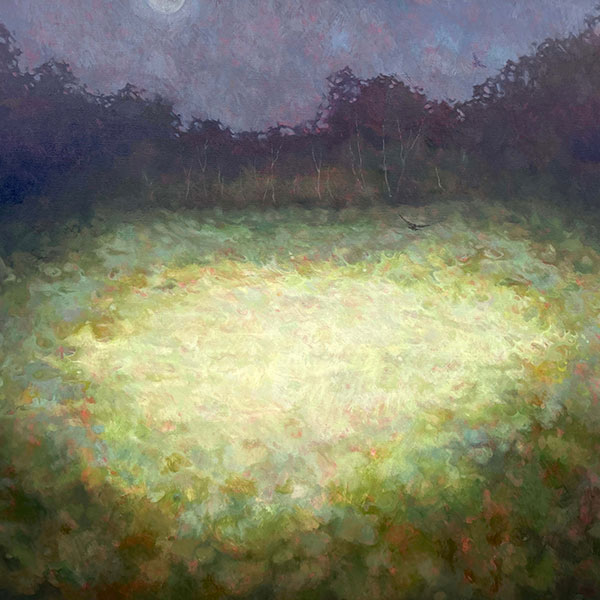
Night Encounter presents a secluded field at night interrupted by an unfamiliar glow emitted on/by the grass. The painting discusses uncertainties through its refusal to provide an explanation for this unnatural glow and a dense darkness that swallows the details of the trees in the distance to reflect the uncertainties of our environment’s future. The artwork is painted upon an acrylic base colour of red which hints of are visible and push through the many layers of softly applied and thinned out oil paint, that have an almost translucent quality. This pairing of a harsh red and soft brushstrokes aids to an unclear tension, that allows the viewer to decide if this field of light is unnerving or provides a moment of solitude.
Asterism presents the quiet private moments when trees tops are hard to differentiate from the night sky due to low light levels, the only clear visible source of light is the stars. Inspired from personal experience of rural landscapes, the piece utilises a soft application of oil paint with minimal brushstrokes and the physical smallness of the work to capture a tranquil yet fleeting moment of stargazing.
Zoë Eady
Zoë Eady is a multimedia artist and maker of things. The focus of her practice is on making beautiful and engaging physical objects (glass, wood, plastics, paper) through experimentation and problem solving. She draws influence from illustration, narrative, and observational daily drawing. At the heart of her practice runs the reoccurring themes of nature, and play.
Forest Shadows invites you to create your own shadow characters and stories in this illuminated woodland theatre.
How it was made:
Zoë combines both digital and analogue processes in her creative practice. Every part of this silhouette design started life as an individual hand cut paper shape. She later translated them into laser cut wood for strength and durability.
She explains that doing everything digitally makes her work look lifeless and flat, whilst doing everything the analogue way limits the scope of what can be achieved. ‘The trick is to find a balance and use it as a tool and not a medium.’
Thank you to Catherine Morton for the loan of the overhead projector.
THE ZINE LIBRARY
Find the artists featured in our Soft Light Zine Library;
Annie Kaur / Damian Whittle / Deb Living / Fajar Kayani / Hannah Ackroyd / Kathryn Wright / Lynn Stinson / Mary Tallontire / Phil Bixby / Robyn Lawrence / Summer Shepherd
