



In the absence of Farsley’s own professional spook-catchers, Museum & Archive Assistant Dan investigates.
Working at the mill late one night, I was looking through our accident book. Not our current one of course; this is the one from when the mill was still operating, with entries from 1935 to 1978. It is a good quality book, properly bound, of the early-twentieth century type. It has seen lots of use though, so much that it has ended up covered (quite tidily, it has to be said) in brown paper. The word ‘ACCIDENT’ is written in the middle of the front cover in black ballpoint, surrounded by lots of scribbles where different people from down the years have tested to make sure that their pen works.
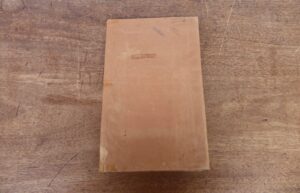 Image: Our old accident book.
Inside tells a similar story of craftsmanship put to hard work. When we begin in April 1935, we find a bold cursive written with a smooth fountain pen, but by July 1936 this reverted to scribbled pencil. This persisted for the next 30 years with occasional entries in ink, before ballpoint took over in January 1966. At some point, somebody spilled water on the pages, dissolving patches of writing into liquid rainbows. Something else that changed was the level of detail we are given: in 1935, the first aider, as I suppose we would call him or her today, provided the date, the person injured, the department they worked in, the part of the body injured, and the type of injury, but gradually this grew to include the time of the accident, the date it was reported, and a brief description of the accident as well.
Even without the ‘Description’ column though, I had already begun to notice some eerie entries. On the first page, one of the first records describes a member of the spinning department receiving a ‘spell’ to the ‘thumb’. These ‘spells’ continue throughout the decades and are associated with people working in all departments of the mill, suggesting that curses and hexes (or perhaps just wooden work surfaces and wicker skips and skeps) were very widespread. I think we can make a connection here to the broomstick-esque brushes that we look after. Before the invention of the vacuum cleaner, these were used for sweeping up threads and fibres around the mill, and the reed brush-heads could probably give you a nasty splinter!
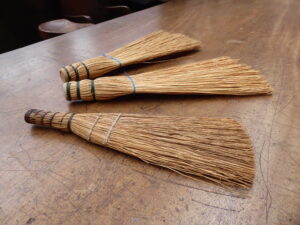
Image: A selection of brushes, made from lots of thin, golden-yellow reeds bound together with wire and string. Perhaps used for flights around Farsley after hours. You can see them more closely on our Weaving the Web page.
Also on the first page, we find our first record for someone working in an often-overlooked part of the mill: the canteen. Without their hearty food though, would the weavers, the spinners, the dyers, the menders, and all the rest have been able to produce some of the best cloth in the world? I think the canteen staff should probably get more appreciation, not least because they seem to have received most of the injuries! Repeatedly through the first few pages, they are listed as ‘scalded’ and receiving ‘burns’ on ‘pans’. What ingredients would we find in these bubbling cauldrons? ‘Boiling semolina’ and ‘hot fat’ are the things that we are told about when the ‘Description’ column appears, but perhaps there was some ‘eye of newt, toe of frog, wool of bat, and tongue of dog’ in their concoctions as well.[i]
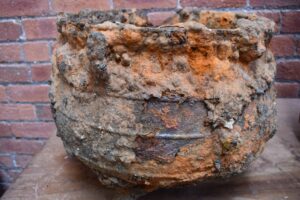
Image: Appropriately, we also have a witch-like (and very rusty) cauldron in our collections! This was found when one of the millponds was drained in a few years ago and may have been used in the dye process. If you are interested in finding out more about dyes at Sunny Bank Mills, get involved with our new Dyevolution project.
Later on, we find that canteen staff were also victim to few attacks by potentially supernatural creatures: in November 1970, note was made of one unfortunate individual suffering a ‘cat bite, left hand’; again, in November 1971, we read about someone’s ‘scratched right arm (cat)’. Was this a black cat, the familiar of a West Leeds witch? We cannot say. Whatever the real answer, we would like to know more about this mill cat, or any other mill animals from down the years: if you have any memories or photographs that you would be happy to share, please do get in touch.
The Museum & Archive will be open for hauntingly good bespoke tours on both remaining Saturdays in October, including the 31st itself. I do not know if we have ever been open on Halloween, so who knows what could happen? Come and visit us… if you dare.
Macbeth, IV. 1.
Back To Blog Next (From Lockwood to Logwood)Tags
General Museum & Archive Arts & Culture