



‘Archives hold stories so they don’t disappear,’
(Edmund de Waal ‘An Archive’, Ivory Press, 2025.)
At Sunny Bank Mills Museum & Archive, those stories survive in ledgers, wage books, share registers and census records. Together, they offer glimpses into the lives of the people who built the success of the mill and helped shape the textile industry in Yorkshire.
As part of our Dyevolution project we have started trawling our records to uncover some of the individuals who worked in the dyeing industry at the mills in the period spanning the historical dye ledgers at the heart of the project, 1888 to 1910. This has led us to Walter Ellis.
From Lockwood to Logwood – The story of Walter Ellis
Walter Ellis was born in 1850 in Lockwood near Huddersfield, part of an area, like Farsley, experiencing the rapid development of the worsted and woollen industries. He grew up there with his parents and his two sisters and four brothers, most of whom would go on to work in the textile industry. Walter was already working by the time he was eleven. The 1861 census shows that he was a dyer, just like his father and his grandfather. Walter would go on to be the chief dyer at Sunny Bank Mills for many of the years covered in the Dyevolution Project. He would have seen the dye books and been involved in the experimentation, introduction and use of synthetic dyes.
In September 1875 Walter married Jane Cooper, a brewer’s daughter in nearby Milnsbridge Parish Church. They lived there with Jane’s mother, Betty, but by 1882, they had moved to Farsley. Walter’s move was not unusual. Throughout the nineteenth century, skilled textile workers frequently moved between towns and mills in search of opportunity. The expertise developed in the woollen and worsted mills around Huddersfield was highly prized, and Sunny Bank Mills attracted talented workers who could help maintain its reputation for quality. Walter appears to have been one of those workers.
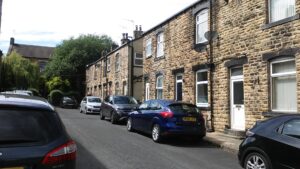
Walter and his family lived at 17, Clara Street, just off New Street and now opposite Westroyd Nursery School. This was regarded as an affluent area of Farsley, and was the home of many of the village’s wealthiest residents. Walter and Jane continued to live there for the rest of their lives. Jane’s mother lived with them, as eventually did their young nephew, Walter Cooper, and their niece Gertrude Cooper.
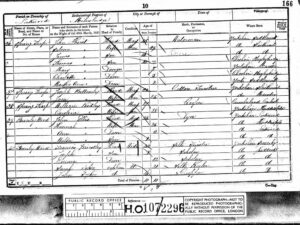

Walter’s name appears in the wage lists as Head Dyer from 1882. In the 1891 census, his occupation is given as ‘foreman dyer’ in a ‘cloth mill’, and in 1901 ‘retired foreman dyer.’ Walter was a very senior person in the mill. He is one of only three workers named in financial company records, besides the owner, Edwin Woodhouse. It shows very precise and detailed entries for what Walter was earning from 1898 to February 1901 when it appears he retired.
However, by 1902, Walter was dead. Dyers often did not to live to a very old age. His wife and mother-in-law had died in the previous decade. Between October and December 1902, Walter’s executor, ‘L Ellis’, possibly his youngest brother, Lewis, sold the shares Walter had owned in Edwin Woodhouse & Co.
Our research into Walter Ellis has just begun. There is still much to be done to try and discover more details about his life, and the key part he played in the development of dyes and the dyehouse.
Researcher: Sarah Sutcliffe
Back To Blog Next (National Wool Month & How A Man From Farsley Changed the Yorkshire Textile Industry) Prev (Double Double, Toil and Trouble at the Mill)Tags
General